
How EDR Evidence Can Strengthen a Claim When Liability Is Disputed, or Damage Appears Minor
If you've been injured in a car accident in Vancouver or anywhere in Southwest Washington, one of the most important pieces of evidence in your case may already exist, stored silently in the vehicle that hit you. It's called an event data recorder, and most drivers have never heard of it.
At The Scott Law Firm, PLLC, attorney Colin Scott knows how to identify, preserve, and use EDR data as part of building a strong claim for injured accident victims. If you were hurt in a crash and the other driver is disputing what happened, or if the visible damage to your vehicle looks minor but your injuries tell a different story, EDR evidence may be exactly what your case needs.
What Is an Event Data Recorder?
An event data recorder, commonly referred to as an EDR, is a device built into most modern passenger vehicles that records specific vehicle data in the moments surrounding a crash. The National Highway Traffic Safety Administration (NHTSA) has regulated EDRs in light vehicles since 2006 and required them as standard equipment in all new passenger cars and light trucks since model year 2013.
EDRs are sometimes compared to the "black boxes" used in commercial aircraft, though the analogy is imperfect. A vehicle EDR doesn't record continuous data throughout a trip. Instead, it captures a snapshot of specific data points triggered by a crash event, typically defined as a change in velocity that exceeds a certain threshold. The device records what was happening in the seconds immediately before, during, and sometimes after that event.
It's worth noting that an EDR is a distinct device from a dash cam. As discussed in our earlier post on obtaining crash video in Washington, a dash cam is an optional, aftermarket, or factory-installed video recording device that requires the owner to equip their vehicle with one. An EDR, by contrast, is factory-installed and present in virtually all modern vehicles, whether the driver knows it or not.
What Data Does an EDR Capture?
The specific data recorded by an EDR varies by vehicle make, model, and year, and the precise parameters depend on the manufacturer's configuration. However, under NHTSA regulations codified at 49 CFR Part 563, vehicles equipped with EDRs that meet the regulatory threshold must record a defined minimum set of data elements.
These typically include:
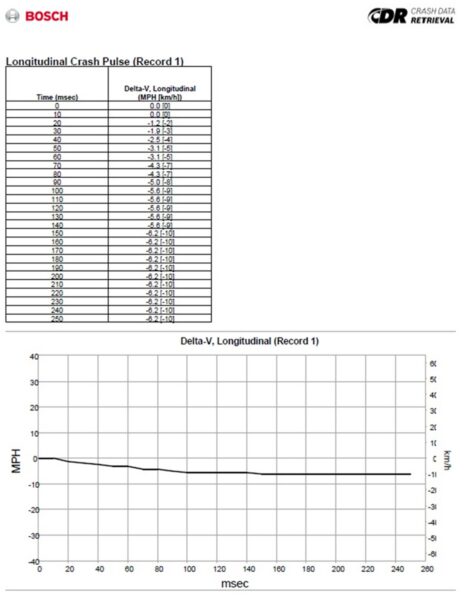
- Delta-V (change in velocity): The change in the vehicle's speed during the crash event, measured in miles per hour. This is one of the most significant data points in a personal injury claim and is discussed in more detail below.
- Pre-crash vehicle speed: The speed of the vehicle in the seconds before the crash trigger occurred.
- Brake status: Whether the brakes were applied before the crash event, and to what degree.
- Throttle position: The position of the accelerator in the pre-crash period.
- Engine RPM: The engine's rotational speed in the pre-crash seconds.
- Seat belt status: Whether the front seat occupants' seat belts were buckled at the time of the event.
- Airbag deployment data: Whether airbags deployed, and if so, the timing of deployment relative to the crash event.
- Steering input: In many newer vehicles, the direction and degree of steering wheel input before the crash is recorded.
Some manufacturers record additional data beyond the regulatory minimum, and newer vehicles with advanced driver assistance systems may capture significantly more. The availability and completeness of EDR data in any given case depend on the vehicle involved, whether its sensors are operating properly, and requires retrieval by someone with the proper equipment and training.
Why Delta-V Data Matters in Low-Impact Cases
One of the most practically important applications of EDR evidence in personal injury claims involves cases where the visible property damage to a vehicle appears modest, but the occupants sustained significant injuries. This is a situation that insurance companies frequently exploit. When photographs show only minor damage to a bumper or door panel, adjusters sometimes argue that the impact was too minor to have caused the injuries the claimant describes.
Delta-V data directly challenges that argument. Delta-V measures the actual change in velocity experienced by the vehicle during the crash, which is a more accurate proxy for the forces experienced by the vehicle's occupants than visible property damage alone. A low-speed crash can produce a meaningful change in velocity depending on the mass of the vehicles involved, the angle of impact, and the stiffness of the structures that absorbed the force. Conversely, some high-damage impacts distribute forces in ways that produce relatively lower occupant loading.
In short, vehicle damage photographs and delta-V measure different things. When an insurer argues that minor visible damage indicates a minor impact, EDR data can provide objective evidence that the actual forces involved were greater than the property damage suggests.
How EDR Data Is Retrieved
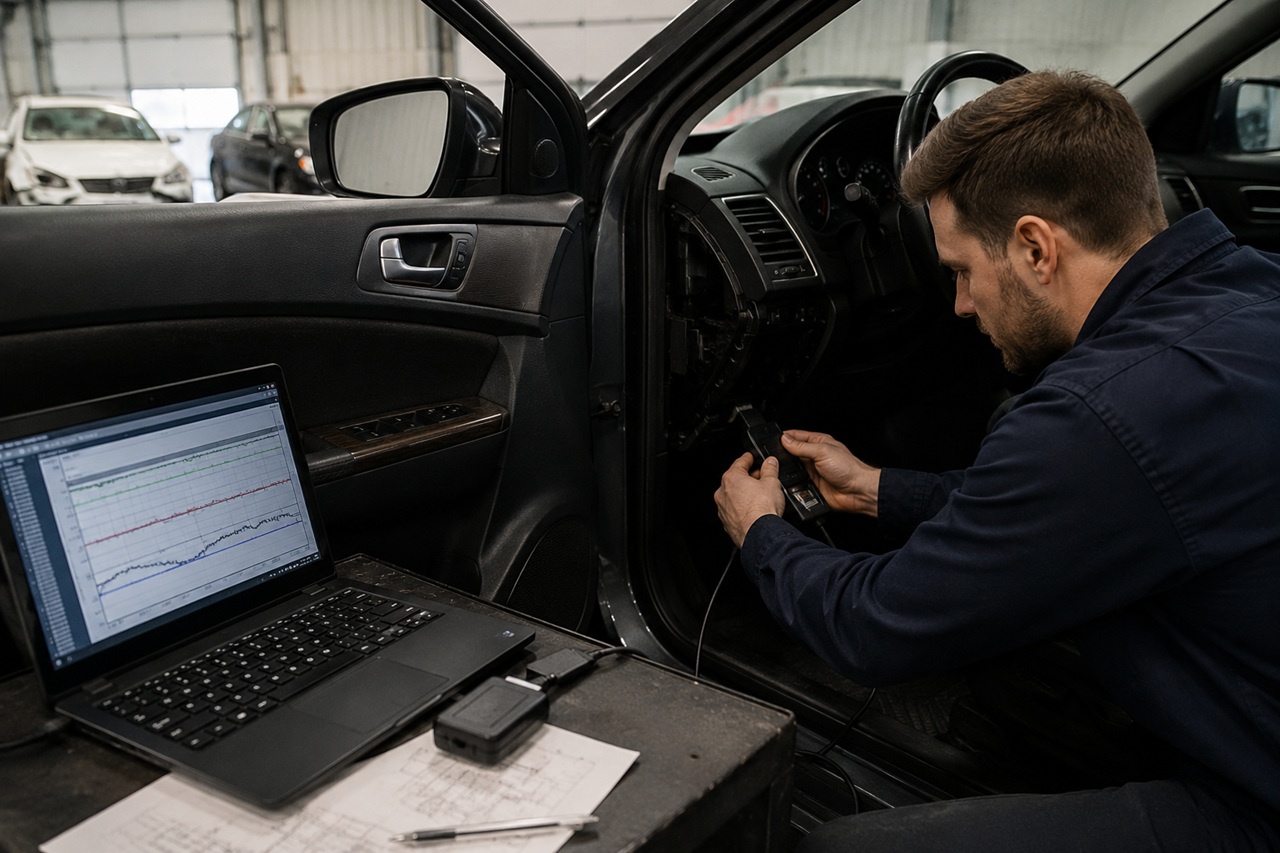
Retrieving EDR data requires specialized hardware and software, most commonly the Bosch CDR (Crash Data Retrieval) system, which is the industry standard tool used by law enforcement, accident reconstructionists, and forensic engineers. It is designed mainly for use with passenger cars, light trucks and SUVs. The process involves physically connecting the retrieval tool to the vehicle's diagnostic port or, in some cases, directly to the EDR module itself, and downloading the stored data file.
The resulting output is a CDR report that presents the recorded data in a standardized format. Properly interpreting that report, and translating it into a form that is meaningful and admissible in the context of a legal claim, typically requires a qualified accident reconstructionist or forensic engineer with specific training in EDR data analysis.
It is also worth noting that not every crash triggers EDR recording. The device captures data only when the crash event meets the threshold for recording, meaning lower-speed incidents that don't meet that threshold may not generate retrievable EDR data even in vehicles equipped with the device. If the vehicle's sensors are not working properly, this may also result in the EDR failing to record any data.
Who Owns the EDR Data, and Who Can Access It?
EDR data ownership and access rights are governed by a combination of federal regulation and state law. Under 49 CFR Part 563.11, EDR data belongs to the owner of the vehicle. This means that in most cases, the data from the at-fault driver's vehicle belongs to that driver or their insurance company, not to you.
Washington State addresses EDR data access under RCW 46.35.010 et seq., which governs the retrieval and use of vehicle data recorder information. Under Washington law, EDR data generally may not be retrieved without the consent of the vehicle owner, or pursuant to a court order, a search warrant, or as part of a civil discovery process. This means that in a disputed liability case, obtaining the at-fault driver's EDR data may require formal legal process, which is another reason why prompt involvement of an experienced attorney matters.
The Preservation Problem: Why Acting Quickly Is Critical
EDR data can be lost. Vehicles are repaired or totaled after crashes, and once repair work begins or a salvage yard takes possession of a vehicle, the opportunity to retrieve EDR data may be gone. The data itself can also be overwritten in some circumstances by a subsequent crash event that meets the recording threshold. The EDR's data may also be overwritten automatically once the key ignition is turned over so many times.
In a case where EDR evidence may be important, the single most time-sensitive step can be sending a preservation letter (sometimes called a spoliation letter) to the at-fault driver, their insurance carrier, and any vehicle custodian, placing them on notice that the vehicle and its data must be preserved pending litigation. Failure to preserve evidence after receiving such notice can result in legal consequences, including an adverse inference instruction at trial, meaning a jury may be told that it can infer that the destroyed evidence would have been unfavorable to the party that failed to preserve it.
EDR Evidence in the Broader Context of a Car Accident Claim
EDR data is one tool among several that a well-prepared attorney can use to build a strong accident claim. It works alongside police reports, witness statements, crash video, medical records, and expert testimony to establish what happened. In some cases, EDR evidence can be a decisive factor. In others, it can provide useful corroboration of a version of events that's already supported by other evidence.
What EDR data cannot do on its own is establish legal liability. The data tells you what the vehicle was doing. It takes an attorney who understands how to work with that evidence, how to retain the right experts, and how to present it effectively to translate raw data into a compelling legal argument.
Washington follows a pure comparative fault rule under RCW 4.22.005, which means an injured person's recovery is reduced in proportion to any fault attributed to them. EDR data from the at-fault vehicle can play an important role in rebutting attempts to shift a portion of that fault onto the injured party, particularly in cases where the other driver claims the injured person contributed to the crash through their speed, braking, or steering behavior.
Hurt in a Vancouver, WA Area Accident? Get Legal Help Before Evidence Disappears.
If you were injured in a car accident in Vancouver or Southwest Washington, the evidence that supports your claim may be sitting in the other vehicle right now, but it won't stay there indefinitely.
Attorney Colin Scott understands how to move quickly to identify, preserve, and use EDR data and other critical evidence on behalf of injured clients. He handles car accident claims, truck accident cases, and personal injury claims throughout Clark County and Southwest Washington on a contingency fee basis, meaning there are no upfront fees and you pay nothing unless we recover compensation for you.
Contact us today for a free consultation, or call us directly at 360-718-3640.
Client Testimonial
"Colin and his team were fast, communicated amazingly, got me a good chunk of money and always had time to talk to me. Highly recommend them." - Sean M., ⭐⭐⭐⭐⭐
Disclaimer
Web content is not legal advice. Using this website does not establish an attorney-client relationship. If you have questions about a legal matter, you should consult with an attorney who is licensed to practice law in the appropriate jurisdiction and is familiar with the facts in your situation. To learn more about how The Scott Law Firm, PLLC can assist you with a personal injury related matter, contact our office today for a free consultation: (360) 295-2608.