
Washington Delivery Workers May Have Multiple Paths To Compensation After A Dog Attack
A routine delivery can become dangerous in seconds when an unrestrained dog charges a worker approaching a front porch, driveway, or gate. Amazon drivers, USPS letter carriers, UPS and FedEx employees, food-delivery couriers, utility workers, and others who make daily doorstep visits face a risk that many customers rarely consider until an attack occurs.
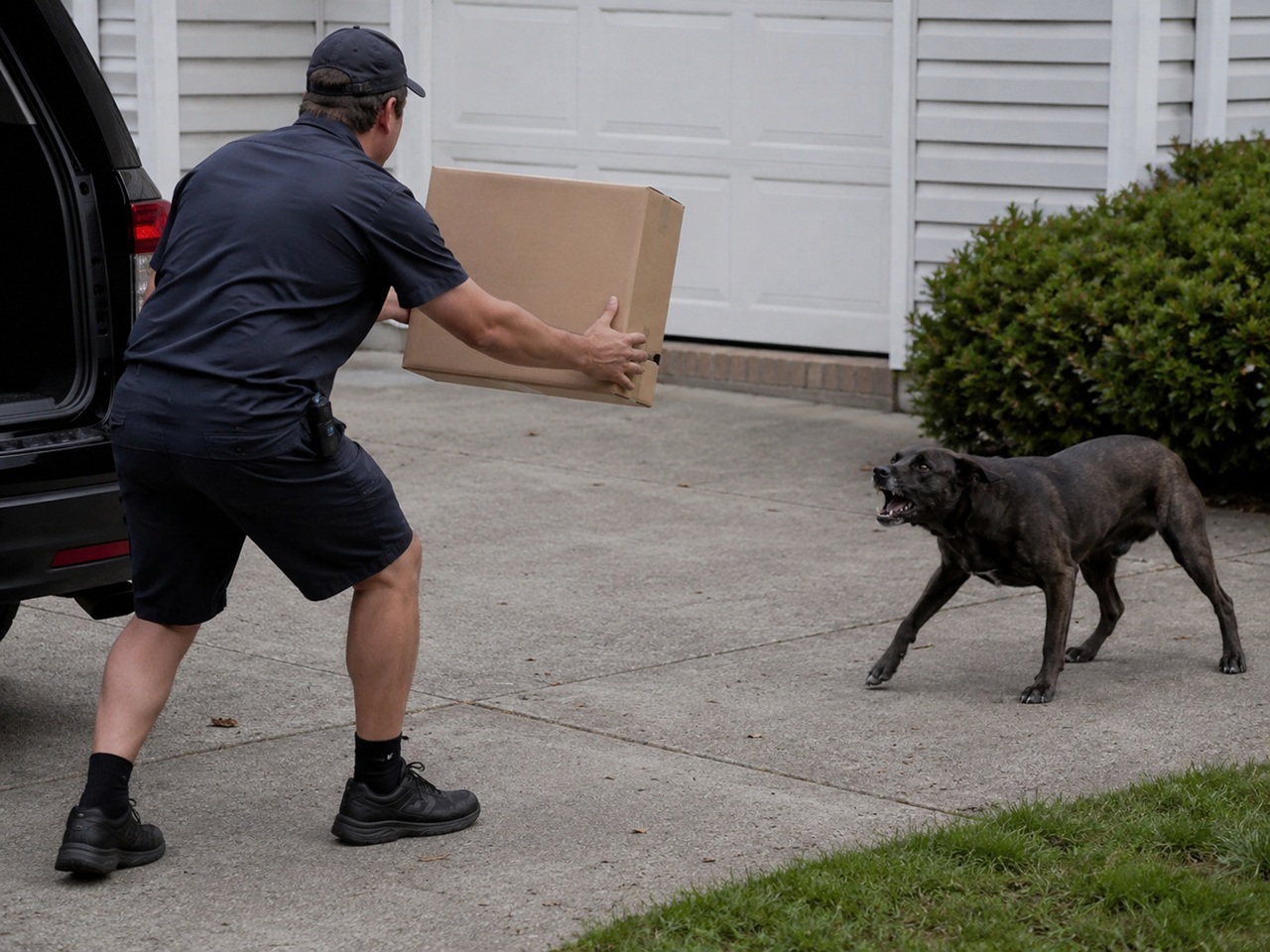
A viral video circulated in July 2026 showing a UPS driver throwing a package toward a dog that appeared to be charging before the driver became involved in a heated confrontation with the dog’s owner. Whatever happened after the immediate encounter, the footage raises an important question for workers who face aggressive dogs on the job: Can taking reasonable steps to defend yourself against a charging animal affect your right to recover compensation?
At The Scott Law Firm, PLLC, we represent injury victims in Vancouver and throughout Southwest Washington, including delivery workers who are attacked by dogs while performing their jobs. If you are a delivery worker and have questions about a potential dog bite injury claim, contact our office today to schedule a free consultation with an experienced dog bite attorney.
More Than 5,200 USPS Workers Faced Dog Attacks In 2025
The risk is not hypothetical. The United States Postal Service reported more than 5,200 dog attacks on its employees nationwide in 2025. Keep in mind, that figure only covers USPS employees. It does not include dog-related injuries suffered by private package carriers, food-delivery drivers, app-based workers, utility technicians, and other types of delivery workers.
Delivery work creates repeated exposure to conditions that workers cannot fully predict. A dog may escape through an open garage or front door, run around the side of a house, push through a loose gate, or be left unsecured in a yard. Even a dog that has never bitten anyone before may react aggressively when an unfamiliar person approaches the property.
Washington’s Strict-Liability Law Protects Many Dog-Bite Victims
Under RCW 16.08.040, the owner of a dog is held strictly liable for damages if their dog bites a person who is in or on a public place or lawfully in or on a private place, including the dog owner’s property. The statute applies regardless of whether the dog has bitten or attacked someone before.
RCW 16.08.050 further provides that express or implied consent can establish lawful presence on private property (within the meaning of RCW 16.08.040). However, consent is not presumed when the property is fenced or reasonably posted.
Together, the above statutes may allow for delivery workers to lawfully enter the property of another under certain limited conditions for the purpose of making a delivery, so long as the delivery worker has express or implied consent to do so. Note that consent will not exist in every situation. For example, the presence of a fence, gate, no trespassing sign, etc. could change the analysis.
Individual Conduct Can Lead to a Dispute Over Provocation
Under RCW 16.08.060, proof that the injured person provoked the attack is a defense to an action for damages under Washington's strict liability dog-bite statute. But what constitutes "provocation" when a dog attacks someone?
That question is more complicated than it may initially seem. A challenge is that the statute does not directly define “provocation.” There is some guidance as to how the term "provocation" applies under Morawek v. City of Bonney Lake, 184 Wn. App. 487, 495–97, 337 P.3d 1097 (2014). Although Morawek interpreted a municipal dangerous-dog ordinance rather than RCW 16.08.060, the Court of Appeals applied the ordinary meaning of provocation as conduct that incites a response or affects reason and self-control. The court also explained that provocation may be established through direct evidence or circumstantial evidence, but not through mere speculation.
The timing and sequence of the dog bite incident may therefore be critical. If a delivery worker pokes a dog with a stick repeatedly and entices it to attack, such conduct may be perceived to rise to the level of provocation. If the dog is already showing signs of aggression, however, or the dog is charging and a delivery worker throws a package at the dog, uses a mailbag as a barrier, or retreats, or takes another split-second action to protect themselves and avoid injury, such evidence could show the worker reacted reasonably to an existing threat.
It is difficult to know what specific actions might lead to a finding of provocation in the abstract. The answer, really, is that it depends on the individual facts and circumstances of the attack. It appears whether someone “provoked” a dog bite is a factual finding and therefore a question for a jury to decide, rather than a question of law that is decided by a judge. Moreover, Washington's strict liability statute is not the only way to prove liability when a dog bites someone and causes injury. There are other methods that can be used to prove liability when a dog bites or attacks, discussed further below.
A Charging Dog Can Cause Injuries Even Without a Bite
The plain wording of Washington’s strict-liability statute (RCW 16.08.040) applies whenever a dog bites and injures someone. It does not, however, say anything about other types of injuries that can result from an attack.
For example, a delivery worker may fall while retreating from a charging dog, twist a knee while jumping over a fence to escape, suffer a head injury after being knocked down, or even seriously injure their arm while using a heavy package or mailbag as a barrier. To determine liability under these circumstances (i.e. when a dog attacks but does not bite someone), such injuries may be evaluated under Washington common law.
Washington recognizes two common-law theories. First, an owner, keeper, or harborer who knows or reasonably should know that a dog has vicious or dangerous propensities likely to cause the type of injury complained of may be strictly liable for resulting harm. Arnold v. Laird, 94 Wn.2d 867, 870–71, 621 P.2d 138 (1980); Johnston v. Ohls, 76 Wn.2d 398, 400–04, 457 P.2d 194 (1969). Liability under this theory depends on ownership or direct control of the animal. Frobig v. Gordon, 124 Wn.2d 732, 735–37, 881 P.2d 226 (1994).
To be clear, a prior bite is not required. The responsible person must know or have reason to know of a propensity that would be likely to cause the type of accident at issue (Johnston, 76 Wn.2d at 403–04). In Johnston, the plaintiff was injured when a dog ran into the roadway and collided with, chased, or attempted to attack his motorcycle. Evidence that the dog had previously chased bicycles and motorcycles was relevant because it concerned behavior related to the injury-producing event.
Accordingly, prior incidents involving charging, chasing, pursuing passersby, or escaping confinement may establish notice when the claimed injury resulted from retreating, falling, or colliding with the dog. The evidence must reveal a propensity connected to the kind of harm alleged; so, for example, unrelated behavior such as barking or excitement may be insufficient.
Second, Washington common law also recognizes liability for negligent control even when the dog was not known to have dangerous propensities. Under this analysis, a negligence claim may arise when an animal is ineffectively controlled under circumstances in which injury could reasonably have been expected, and that failure proximately causes the harm. Arnold, 94 Wn.2d at 871; Sligar v. Odell, 156 Wn. App. 720, 731–32, 233 P.3d 914 (2010).
The degree of control reasonably required depends on the full circumstances, including the dog’s character and past behavior, the method of restraint, the condition of fences or gates, the location of the encounter, and the injuries that could reasonably have been foreseen. Arnold, 94 Wn.2d at 871; Sligar, 156 Wn. App. at 731–33.
The mere fact that a dog was unleashed or unconfined does not automatically establish negligence.
The evidence must show that the responsible person failed to exercise reasonable control under the circumstances and that the failure foreseeably and proximately caused the injury.
These common law theories of negligence may be pursued, generally, whenever a dog bites and/or attacks someone and causes injury.
Evidence From The Doorstep Can Decide A Disputed Dog Attack Claim
Delivery workers nowadays often have one advantage that wasn't very common just a few years ago: many dog attacks are now recorded on video.
Doorbell cameras, home surveillance systems, delivery-vehicle cameras, body-worn devices, and neighboring security cameras may capture exactly when the dog appeared, whether it was restrained, what the worker did, and how the owner responded.
Other useful evidence can include:
- Photographs and Video: Document injuries, torn clothing, the property, fences, gates, warning signs, and the location where the encounter occurred.
- Delivery Records: App logs, route information, timestamps, and delivery instructions can help establish why the worker was on the property and the items they were tasked with delivering.
- Witness Information: Neighbors, customers, coworkers, or other people nearby may have seen the attack or know whether the dog had behaved aggressively before.
- Medical Records: Prompt treatment documents the injuries and can help connect them to the attack.
- Animal Control Records: Victims of an attack should immediately contact Animal Control to report what happened.
Video can disappear quickly if a homeowner deletes it or a camera system automatically overwrites old footage. Preserving that evidence early can become especially important when the owner argues that a delivery worker was trespassing or provoked the dog.
Delivery Workers Should Document And Report The Attack Quickly
After getting to a safe location, an injured worker should prioritize their medical care first, followed by documentation.
- Get Medical Attention: Dog bites can cause puncture wounds, infections, nerve damage, scarring, and other injuries that require prompt treatment.
- Report the Work Injury: Employees should follow applicable workplace reporting procedures so there's a record that the incident happened while they were working.
- Report the Dog Attack: Promptly reporting a dog bite or attack to Animal Control and/or law enforcement can create an official record and help identify the animal and owner.
- Preserve Delivery Information: Save screenshots, delivery instructions, route data, messages with the customer, and any notice showing why you were at the property, how long you were there, and what you were delivering.
- Identify Available Cameras: Doorbell and surveillance footage should be located and obtained quickly before recordings are deleted or overwritten.
Contact Our Vancouver Dog Bite Lawyer Today
Every dog attack is unique and must be evaluated on its own merits. Attorney Colin Scott has considerable experience representing dog attack victims and can fight to protect your legal rights and obtain just compensation. If you were bitten or injured by a dog while making a delivery in Vancouver or Southwest Washington, contact us for a free consultation to discuss your potential legal options.
Client Testimonial
"I reached out to Colin after I was attacked by a husky, and at first I honestly didn’t believe I would get that much for it and really thought it was going to be a waste of time. But I couldn’t have been more wrong. ...I didn’t believe I was going to get paid as much as I did, but Colin fought for me and got me way more money than I expected, and I was well compensated for what happened." - Justin C., ⭐⭐⭐⭐⭐
Disclaimer
Web content is not legal advice. Using this website does not establish an attorney-client relationship. If you have questions about a legal matter, you should consult with an attorney who is licensed to practice law in the appropriate jurisdiction and is familiar with the facts in your situation. To learn more about how The Scott Law Firm, PLLC can assist you with a personal injury related matter, contact our office today for a free consultation.