
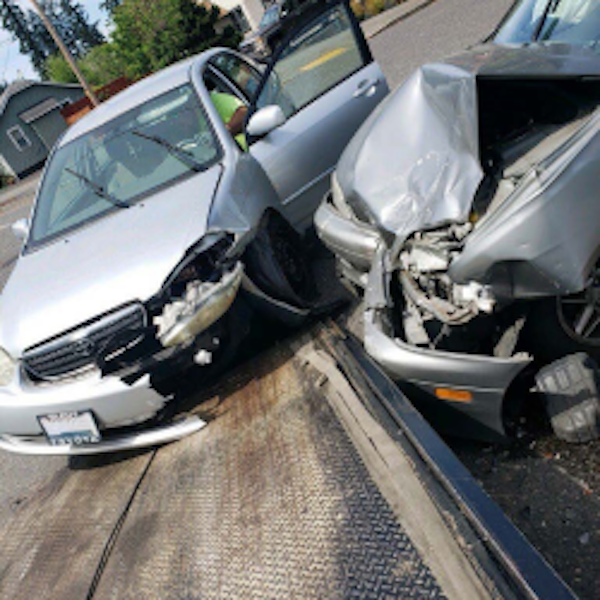
An Experienced Vancouver Car Accident Lawyer Can Fight for Your Rights
If you're involved in a car accident and there has been an injury, a police officer will typically arrive, take statements from both drivers and any witnesses who are present, and obtain relevant documents at the scene (such as driver’s license and proof of insurance). But what if they leave without issuing a citation to the at-fault driver? For many crash victims, that moment raises a specific and understandable fear that if no one got a ticket, no one was legally at fault. However, in Washington State, a traffic citation and civil liability are two separate matters. And while it can certainly be helpful if the at-fault driver is cited for causing the collision, the absence of a ticket doesn't extinguish your right to pursue compensation.
What is the difference between a traffic citation and civil liability?
A traffic citation is a law enforcement action that is typically taken under Washington's traffic code (titled “Rules of The Road”). Officers issue citations based on what they personally observed or can verify based on evidence and witness accounts taken at the scene. If an officer didn't witness the accident, that can sometimes create evidentiary issues that prevent them from issuing a citation or bringing criminal charges of some kind. If both drivers who are involved in an accident give conflicting accounts and there is no clear evidence favoring one driver over the other, the officer may choose not to issue any citations. Or, if in the officer’s judgment, there is insufficient evidence to issue a citation, they may choose not to issue a ticket of any kind (even when they suspect there was wrongdoing).
Civil liability operates under a different framework. In Washington, the majority of personal injury claims are proven by establishing what is called a “prima facie” showing negligence, where the injured plaintiff must demonstrate the following:
- Duty: The defendant driver must have owed a duty to others, including the injured plaintiff. An example of this is the common law duty to exercise ordinary care in the presence of others, including motorists who are operating motor vehicles on public roadways in the State of Washington.
- Breach: The defendant driver, through action or inaction, must have breached the applicable standard of care.
- Causation: The defendant driver’s breach of care must have directly and proximately caused the crash and the resulting injuries.
- Damages: The injured plaintiff must have suffered actual harm as a result.
Not all personal injury cases are prosecuted under a theory of common law negligence. Some may be prosecuted under a negligence per se theory of liability (such as in cases where a statutory duty, like a traffic law, has been violated). Or, in special cases that involve common carriers such as buses and other forms of public transportation, the bus driver may be held to an even higher duty and standard of care to their passengers (the “highest degree of care”).
Regardless of the specific theory of liability that is chosen in a personal injury case, civil cases in Washington are generally decided under the preponderance of the evidence standard, which requires that the injured party must show it is more likely than not the other driver breached their duty of care owed to the injured plaintiff and was negligent. This, by the way, is a lower evidentiary standard than the “beyond a reasonable doubt” standard that is used in criminal proceedings.
Citations issued by law enforcement for traffic infractions also follow the preponderance of evidence standard. Thus, when a citation is issued following a traffic accident, the judge must determine, on a more likely than not basis (greater than 50%), whether the party cited has committed the infraction.
How is fault established when no citation was issued?
The police report still matters, in the sense that it contains detailed information about the accident and parties involved, and can be obtained through the Washington State Patrol web portal once the report is available. It may document vehicle positions, road conditions, and witness statements that are useful to a civil claim. However, the report itself is what is called “hearsay” evidence (an out-of-court statement used to prove the truth of the matter asserted) and is generally not considered evidence that is admissible in court.
In the absence of a citation, additional evidence can be especially important. For example, an attorney may use the following pieces of evidence to reconstruct what happened:
- Photographs and video from the scene, such as dashcam footage, traffic cameras, or nearby business surveillance
- Testimony from independent eyewitnesses who observed the collision
- Physical evidence such as skid marks, vehicle damage patterns, debris fields, and point-of-impact analysis performed by experts who are qualified to testify about these matters
- Cell phone records, which can particularly be relevant in distracted driving cases
How do insurance companies handle claims when fault is unclear?
Insurance companies conduct their own liability investigations independent of law enforcement. Under WAC 284-30-370, Washington insurance providers must promptly acknowledge and reasonably investigate claims, generally within 30 days, but sometimes it may take longer. That investigation will include the police report, vehicle damage, photographs, and recorded statements.
When fault isn't clearly established by a citation, insurance adjusters for the opposing driver may attempt to assign partial or full responsibility to you in order to reduce or deny the claim. They may seek a recorded statement early in the process, before you have had time to consult with an attorney or fully assess your injuries.
Importantly, there is no law that requires you to provide a recorded statement to the at-fault driver's insurance company. Doing so without legal counsel can compromise your claim. The terms of your own motor vehicle insurance policy may require you to cooperate with your own insurance provider. But that obligation doesn't extend to the opposing party's insurance company.
What if I’m found partially responsible for causing the accident?
The insurance companies investigating the accident may claim that you are fully or partially responsible for causing the accident. This is only their opinion and it has no legal bearing on your civil rights as far as filing a lawsuit against those you feel are responsible for your injuries. Washington also follows a pure comparative negligence rule in civil cases under RCW 4.22.005. Therefore, even if you're found partially at fault, you may still recover damages proportionally reduced by your percentage of fault.
Consult a Vancouver lawyer who knows how to build strong car accident cases
If you were injured in a car accident in Vancouver or Clark County and no citation was issued, that alone shouldn't lead you to conclude you have no case. At The Scott Law Firm, PLLC, attorney Colin Scott has worked in the personal injury field for more than 20 years. During his career, he has represented hundreds of injured plaintiffs and recovered millions on behalf of his clients, including clients who were injured in traffic accidents, throughout Vancouver, Clark County, and the surrounding southwest Washington area. He has also successfully reversed the liability decisions of insurance companies following an accident, including scores of claims where no citation has been issued.
He knows how to gather the evidence, build a case that holds negligent drivers accountable, and handle every aspect of your claim while you focus on your recovery. Insurance companies have adjusters and attorneys working to protect their interests from the moment a claim is filed. You deserve the same level of representation working for you.
There are no upfront costs and no hidden fees. The Scott Law Firm, PLLC represents injured clients on a contingency fee basis, and we only get paid if we win. Your first consultation is completely free. Contact us online or call today to discuss the facts of your situation and understand your legal options.
"I would for sure recommend Colin Scott to anyone, great guy to work with. He really knows what he is doing. Both my wife and I were very pleased with the result. Thank you!" - Mike, ⭐⭐⭐⭐⭐
Disclaimer
Web content is not legal advice. Using this website does not establish an attorney-client relationship. If you have questions about a legal matter, you should consult with an attorney who is licensed to practice law in the appropriate jurisdiction and is familiar with the facts in your situation. To learn more about how The Scott Law Firm, PLLC can assist you with a personal injury related matter, contact our office today for a free consultation: (360) 718-3640.