
How Video Evidence Can Strengthen Your Washington Car Accident Case
A Washington Car Accident Lawyer Explains Why Crash Footage Matters
A car accident in Washington can get confusing quickly. The at-fault driver who ran a red light on Fourth Plain Boulevard in Vancouver might deny doing anything wrong. A speeding driver who changed lanes without warning on I-5 might change their story after the crash. That’s why strong evidence matters so much for a Washington car accident claim.
Video footage can be some of the most important evidence in a car accident case. Instead of leaving the determination of fault to competing stories, video can show how the collision occurred and what each driver did in the seconds before impact.
At Scott Law Firm, PLLC, we know how powerful that kind of evidence can be. A Vancouver, Washington car accident lawyer often has to deal with insurance companies that question fault, minimize injuries, or suggest shared blame. When car accident video footage exists, it can be compelling evidence that injured victims can use to support their case.
How Video Evidence Helps Prove Fault in a Washington Car Accident Case
Fault is at the foundation of any car accident claim. Without clear proof of who caused the crash, the insurance company has more room to dispute your claim or reduce what it pays. In Washington, fault can directly affect the amount of compensation an injured victim can recover.
Washington follows a pure comparative fault standard. Under state law (RCW 4.22.005), contributory fault does not bar recovery in a personal injury claim, but it reduces the injured victim’s damages in proportion to the percentage of fault assigned to them. In practical terms, an injured victim found 20 percent at fault can still recover compensation, but the compensatory damages award is reduced by that 20 percent share of fault. That means the greater the degree of blame an insurer assigns to you, the less it may owe.
Video evidence can help to limit that kind of blame-shifting. Instead of relying only on statements, your case can include visual proof showing how the crash happened. For example, if a driver claims you merged into their lane on SR 14 but video shows that driver crossed the lane line first, that changes the entire liability discussion. That kind of clarity can lead to a stronger position during litigation and settlement negotiations and fewer disputes about fault.
What Kinds of Video Footage Can Support My Washington Crash Claim?
After a crash, there may be more than one source of video footage. Indeed, in many cases, several recordings work together to tell the story of what happened. That is especially true in areas like Vancouver, where traffic, businesses, and residential properties create multiple potential recording angles. Sources of video may include:
- Dash Cam Footage – A dashboard camera can capture the seconds leading up to a crash, including speed, lane position, and driver reactions. It may also show what happened immediately after impact, including vehicle movement, evasive action, and the position of the cars after the collision.
- Security Camera Footage – Nearby businesses often have cameras pointed toward entrances, parking lots, and adjacent streets. These cameras may capture vehicles approaching an intersection or making turns that lead directly to the collision.
- Traffic Camera Footage – Some intersections and highways in Washington are monitored for traffic flow. Not all traffic cameras record or store footage, and some systems are used primarily for live monitoring. Still, if recorded footage exists, it may show signal timing, traffic conditions, or vehicle movement before a crash.
- Cellphone Video – Witnesses, passengers, or drivers may record the aftermath, which they can then share with law enforcement. They may also choose to post photographs and videos on their social media accounts. Photos and video taken immediately after a collision can preserve vehicle positions, debris patterns, skid marks, visible damage, road conditions, and injuries before the scene is cleared.
- Commercial Vehicle Cameras – Delivery trucks, rideshare vehicles, and company fleets often use onboard cameras. If one of these vehicles was nearby, it may have recorded the crash from a different angle.
- Residential Camera Footage – In neighborhood crashes, doorbell cameras and home security cameras may capture the collision or the moments leading up to it. This recently happened in a case we handled where a neighbor's doorbell camera captured a motor vehicle versus pedestrian accident that occurred in a construction zone.
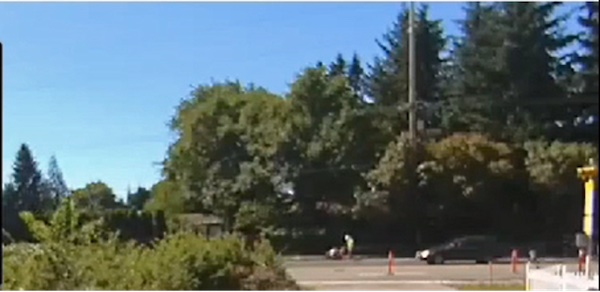
Each of these sources can add a piece to the overall picture. One camera might show the approach to the crash. Another might show the impact. Together, they can create a timeline that is difficult to dispute. When you are not at fault for a crash, the more evidence you have, the better position that you will generally be in to support your case.
Why Video Often Carries More Weight Than Witness Statements
Witnesses can help explain what happened, but they are not always consistent. Even careful observers can miss key details when events happen quickly. Traffic, noise, and shock all affect how people perceive a crash.
Video evidence does not have the same limitations. It does not rely on memory in the same way a witness statement does. It shows movement, timing, and positioning as they actually occurred. That can be especially important when two drivers tell very different stories.
For example, consider a crash at a Vancouver intersection where one driver claims the other entered the intersection too late. A witness might say they are not sure when the light changed. But a camera overlooking the intersection may show the sequence of vehicles, traffic signals, and impact. That level of detail can resolve disputes that would otherwise remain unclear.
This does not mean witnesses are unimportant. It means video can support or clarify what witnesses say. When both align, the case becomes stronger. When they conflict, video often carries more weight because it is less likely to be affected by perception, memory, stress, or later confusion.
How Video Evidence Can Show How a Crash Happened
In many cases, the most important question is not just who was involved, but how the crash occurred. That is where video can provide details that are difficult to establish through testimony alone. Video may capture:
- Running a Red Light or Stop Sign - Footage can show whether a driver entered an intersection after the signal changed or failed to stop completely.
- Unsafe Lane Changes - Video may reveal whether a driver moved into another lane when it was unlawful or unsafe to do so.
- Following Too Closely - In rear-end crashes, liability is often admitted. But footage can show whether the trailing driver braked or took evasive action prior to impact. Video of the crash can also demonstrate whether the at-fault driver was speeding as well as how severe the impact was.
- Turning Errors - A left-turn collision often depends on timing and right of way. Video can show whether the turning driver failed to stop at a red light when they should have or misjudged oncoming traffic and initiated a turn when it was unsafe to do so.
- Delayed Reaction or Inattention - Sometimes footage shows that a driver did not brake or react before impact, which may indicate distraction or lack of attention.
Washington law (RCW 46.61.050) requires drivers to obey official traffic control devices, including traffic signals. Other rules of the road may also apply depending on how the crash occurred, including Washington laws governing lane changes, following distance, turns, speed, and right of way. When video footage shows that a driver violated a traffic rule, it strengthens the connection between the driver’s conduct and the crash.
Once that connection is clear, your case can focus on the damages from the crash, including medical treatment, lost income, and any resulting disruption to your daily life.
Why Acting Quickly Matters When Video Evidence Exists
One of the biggest risks with video evidence is how quickly it can disappear. Many systems automatically overwrite recordings after a short period of time. Some businesses only keep footage for a few days. Others may not preserve it unless they are asked to do so right away.
That means waiting too long can result in losing evidence that could have made your case stronger. A proactive approach is a must. A crash that was clearly recorded one day may no longer be available even just a few days later.
This is especially important in high-traffic areas where cameras are common, but storage is limited. For example, a collision outside a retail store in Vancouver may be recorded clearly, but if no one requests the footage promptly, it may be overwritten as part of the system’s normal cycle.
That’s why early action matters. Identifying possible sources of footage and requesting preservation can make the difference between having strong visual evidence and having none at all.
Can Video Evidence Increase the Value of My Washington Car Accident Claim?
Video evidence does more than explain how a crash happened. In many cases, it directly affects how much your claim is worth. Insurance companies evaluate claims based on risk. If fault is unclear, they have room to argue, delay, and reduce what they offer. When video removes that uncertainty, the entire claim often becomes stronger.
Clear footage can make it harder for an insurance company to deny responsibility or shift blame. That can improve the claim’s settlement value when the footage reduces a genuine liability dispute. If there is no reasonable argument about fault, the focus shifts to your injuries, your treatment, and how the crash has affected your life. That is where many cases gain traction during settlement negotiations.
Video can also support the seriousness of the crash itself. A low-impact argument is one of the most common tactics insurers use to downplay injuries. But when footage shows a hard collision, a sudden impact, or a vehicle being pushed across lanes, that argument becomes much harder to make. In that situation, the evidence supports not just how the crash happened, but the force of the collision and the mechanism of injury.
What You Should Do If You Think Your Crash Was Caught on Video
If you believe a camera may have captured your crash, here are practical steps you can take right away to help preserve that evidence:
- Look for Nearby Cameras - Notice businesses, traffic signals, and homes in the area that may have cameras facing the roadway.
- Speak With Witnesses - If someone mentions that they recorded the crash or the scene afterward, ask for their contact information before they leave.
- Tell The Responding Officer - Let law enforcement know about possible cameras so it can be noted in the report.
- Take Photos and Video Yourself - Document the scene, including vehicle positions, damage, and road conditions.
- Do Not Assume the Footage Will Be Saved - Businesses and property owners may not keep recordings unless someone requests it quickly. It is often a good idea to make such a request in writing and follow up as needed until the footage is securely stored or, better yet, produced.
These steps can help, but they are only part of the process. A legal investigation often goes further by identifying additional sources and formally requesting preservation.
How Can a Washington Car Accident Lawyer Use Video Evidence to Strengthen My Case?
A lawyer’s role is not just to locate footage, but to use it effectively. That includes connecting the video to the rest of your case and presenting it in a way that supports your claim.
A Washington car accident lawyer may:
- Identify likely sources of footage based on the crash location;
- Send preservation requests before recordings are deleted;
- Obtain and review footage alongside police reports, witness statements, photos, and medical records;
- Use the footage during settlement negotiations with the insurance company; and
- Present the footage in court if the case proceeds to litigation.
When there is video that clearly shows how a crash occurred, it often changes how the insurance company evaluates the case. Disputes become harder to justify, and settlement discussions may become more straightforward.
If the case does not resolve through negotiation, that same footage can become one of the strongest pieces of evidence presented to a jury.
How The Scott Law Firm, PLLC, Builds Strong Washington Car Accident Cases
At The Scott Law Firm, PLLC, we understand that strong cases are built on clear evidence and careful investigation. When video footage is available, we move quickly to identify it, preserve it, and use it to support your claim.
We focus on showing what happened, why it happened, and how it affected your life. That means connecting the details of the crash to your medical care, your lost income, and the challenges you face moving forward. When those pieces come together, your case becomes more difficult to dispute.
If you were injured in a crash in Vancouver or anywhere in Washington, and there may be video showing what happened, it is important to act quickly. Evidence does not last forever, and the sooner your case is investigated, the stronger it can be.
Contact our law firm to schedule a free consultation. We can help you understand your options, investigate the available evidence, and take steps to protect your claim from the start.
Disclaimer
The information on this website is not legal advice. Using this website does not create an attorney-client relationship. If you have questions about a legal matter, you should consult with an attorney who is licensed to practice law in the appropriate jurisdiction and familiar with the facts of your situation. To learn more about how The Scott Law Firm, PLLC can assist you with a personal injury matter, contact our office today for a free consultation: (360) 718-3640.
Click here for a printable PDF of this article, “How Video Evidence Can Strengthen Your Washington Car Accident Case.”